Wednesday, November 5, 2008


Monday, November 3, 2008
What He Said...
Andrew Sullivan signs off for the night...
Blogging has been light today because I've said all I want, made my closing argument, and the rest is noise. Take your time to consider your vote. It matters. And pray that we all come to the right decision, and that the losers and the winners accept the result with the requisite grace and grit... Know hope. And get ready. It will be a day to remember.
Friday, October 31, 2008
Jim Wallis and a Religion of Hope
James Dobson released a "Letter From 2012 in an Obama Administration" earlier in the week, which coming from a leader of the religious right, was embarrassing to Christians around the country.
Jim Wallis, also a leader in the evangelical movement, called Dobson out for his biased and hatred-filled prose and asked for an apology. The letter "shows the kind of negative Christian leadership that has become so embarrassing to so many of your fellow Christians in America. We are weary of this kind of Christian leadership, and that is why so many are forsaking the Religious Right in this election."
He goes on to say... "Dr. Dobson, you of course have the same right as every Christian and every American to vote your own convictions on the issues you most care about, but you have chosen to insult the convictions of millions of other Christians, whose own deeply held faith convictions might motivate them to vote differently than you. This epistle of fear is perhaps the dying gasp of a discredited heterodoxy of conservative religion and conservative politics. But out of that death, a resurrection of biblical politics more faithful to the whole gospel--one that is truly good news--might indeed be coming to life."
We can only hope that Wallis' vision for the future comes to pass.
Are Campaigns too Costly?
George Will discussed the price tag attached to this years presidential campaigns as McCain has attempted to discredit Obama's campaign because of the large amounts of money being donated and the offer of public financing he declined.
I think this is the best summary of the situation to date:
"The Center for Responsive Politics calculates that, by Election Day, $2.4 billion will have been spent on presidential campaigns in the two-year election cycle that began in January 2007, and an additional $2.9 billion will have been spent on 435 House and 35 Senate contests. This $5.3 billion is a billion less than Americans will spend this year on potato chips."
You Can Vote However You Like...
This may be the best thing to come out of the entire election cycle!
Thursday, October 30, 2008
Religion is not a hat you can take off...
I found Susan's post to be an interesting summary of the shifts in political voting some parts of the country is seeing, as it relates to our religious views.
"Religion is not a hat that you can take off or put on at will. When I voted in this presidential election (and yes, I've already voted), I didn't take my religion off and leave it outside in the care of an election monitor while I did the civic thing and cast my ballot. So, yes, I think there is a religious reason to vote for one candidate and against the other.
For some, voting their religious values means voting on a set of issues like abortion or gay marriage. To me, religion is the sum of all my values, my fundamental conviction that the world is a divine gift and we humans are responsible for receiving that gift with joy and working with God to serve one another and all living things. God loves this world and we are to love God with our whole hearts and our neighbor as ourselves...
My religious reason for voting for Senator Obama is because I believe in hope. I also believe the fear-mongering of Senator McCain's campaign violated my religious convictions at the deepest level and it was the main reason I did not vote for him and Governor Palin.
But come January 2009, I will not expect any president to do the work of faith for me. I expect, no matter who is president for the next four years, to work side by side with all my fellow citizens to see that we hope for more and we give in to fear less. "
Troubles in the Congo
Yesterday afternoon Rebels in the eastern part of the Congo (DRC) took over the small town of Goma. To many, this is a conflict thousands of miles away in towns we've never heard of, involving people with names we simply cannot pronounce.
But what happened yesterday in Goma is huge. Goma is the capital of the North Kivu province, and sits at the top of Lake Kivu, which seperates Rwanda and the DRC. Tension have been high in the eastern provinces for some time. It is home to the largest UN peacekeeping force on the planet, with over 17,000 troops on the ground. The ongoing conflict stems in part from the Rwandan genocide. Hutu's fled to Uganda and the Congo after the Rwandan genocide, because they feared retaliation from the Tutsi's who had been the target of the genocide. Some of these Hutu's formed militias, which Rwanda and a cultish group of rebels under the leadership of Laurent Nkuda have denounced. The Congolese armies have been collaborating with these militias and the government has failed to control them. Nkuda's group was formed in order to 'defend the Tutsi population' but Nkuda has recently expanded his mission to include the 'liberation of all of the Congo'. The population is largely unsympathetic to Nkuda's cause, and are resenting all Tutsi's in increasing numbers.
Early Wednesday fire was exchanged along the border between Rwandan and Congolose militaries. Citizens began to flee the region and headed for Goma, a small city considered a safe haven for refugees. Nkuda and his rebels then advanced on Goma, but stopped short at the city gates. The citizens and refugees then began fleeing again, this time alongside the Congolese troops who are refusing to fight any longer. They are not being paid regularly and are exhausted from years of tension in the region. Nkuda agreed to a cease-fire with the UN troops left to defend Goma.
UN officials have give the UN troops in Congo permission to defend the city from the rebels if need be. However, they have not been given permission to defend the city from Rwandan troops, who are rumored to be crossing the border and engaging in some of these firefights. There is an increasing sense of frustration with the UN among the civilian population who do not feel any safer with the troops there.
The conflict is rife with ethnic tensions, international controversy and domestic problems. The UN, the Congolese Government and Nkuda have begun another round of peace negotiations, though many are cynical about its potential to change much on the ground. The last deal signed in January 2008 only lasted through August when tensions led to new rounds of violence. Many fear that if a stable solution is not worked out in coming months, the entire region will explode with ethnic and nationalistic violence- and that the presence of 17,000 UN troops will not be a sufficient international response.
Friday, October 24, 2008
Rick & Barack
This week, per his usual brilliance, Rick Reilly wrote about his fantasy football team experience with Barack Obama. Per Obama's usual brilliance, he scoured over the numbers before making some solid judgements. Gotta love those two. http://sports.espn.go.com/espnmag/story?section=magazine&id=3657201
Thursday, October 23, 2008
The Real America
On Wednesday Sen. Obama held a rally in Richmond, VA- a place that by Gov. Palin's definition may be 'real America' simply based on its history. Richmond was the capital of the confederacy, and the capital of a state that hasn't voted for a democratic presidential candidate in 44 years. He confronted the recent (and somewhat outlandish) attacks from the right that democrats are unpatriotic and liberals are un-american, saying:
"There are no real parts of the country and fake parts of the country... There are no pro-America parts of the country and anti-America parts of the country. We all love this country, no matter where we live or where we come from. Black, white, Hispanic, Asian, Native American, young, old, rich, poor, gay, straight, city dweller, farm dwellers, it doesn't matter. We're all together."
Thank goodness Sen. Obama has the sense to denounce the politics of fear and division that some Republicans have resorted to in the final weeks of the election.
Powell also made the point on Meet the Press last week with this story:
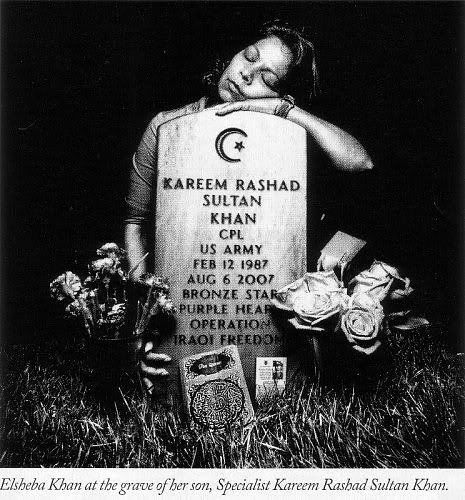
I feel strongly about this particular point because of a picture I saw in a magazine. It was a photo essay about troops who were serving in Iraq and Afghanistan. And one picture at the tail end of this photo essay was of a mother at Arlington Cemetery and she had her head on the headstone of her son's grave. And as the picture focused in you could see the writing on the headstone. And it gave his awards: Purple Heart, Bronze Star. Showed that he died in Iraq. Gave his date of birth, date of death, he was 20 years old. And then at the very top of the headstone, it didn't have a Christian cross, didn't have a Star of David. It had a crescent and a star of the Islamic faith. And his name was Kareem Rashad Sultan Khan. And he was an American. He was born in New Jersey. He was 14 years old at the time of 9-11. And he waited until he could go serve his country and he gave his life.
Now we have got to stop polarizing ourselves in this way. And John McCain is as nondiscriminatory as anyone I know but I'm troubled about the fact that within the party we have these kinds of expressions.
Now we have got to stop polarizing ourselves in this way. And John McCain is as nondiscriminatory as anyone I know but I'm troubled about the fact that within the party we have these kinds of expressions.
Tuesday, October 21, 2008
Powell's Endorsement
" To those who would say he is only supporting Obama as a fellow African American, Powell pointed out that if this were the criterion, he could have made his endorsement months ago. Much more important, I think, is that Powell is a moderate Republican who listens to all this innuendo about terrorism and all this nonsense equating the income tax with socialism and wonders what in the world has happened to his once-grand old party."
That's all folks.
Wednesday, October 15, 2008
THE NUMB3RS
There are now no fewer than seven current national polls that show Obama with a double-digit advantage: Newsweek (+11), ABC/Post (+10), Democracy Corps (+10), Research 2000 (+10), Battleground (+13), Gallup (+10 using their Likely Voter II model) and now this CBS News poll.
The numbers speak for themselves. Though having a few prominent conservative philosophers speak out against McCain surely doesn't hurt either. Chris Buckley (son of William Buckley Jr; founder of the conservative publication, the National Review) resigned over the weekend after public outcry regarding his column last week in which he asked McCain why in the world he would have chosen Palin as his VP. He is the second columnist at the NR to question the choice of Palin, following in the footsteps of Kathleen Parker who received 12,000 pieces of hate mail after her original column,urging Palin to step down, was published in the NR. Buckley quoted Ronald Reagan as he left the NR, saying "I haven't left the Republican Party. It left me."
If Colin Powell endorses Obama after the debate tonight, as expected based on his views on the management of the Iraq war, it will be "the final nail in the coffin of the Republican campaign to hold onto the White House. "
The conservative politicos are in a real quandary with this election, as the republican party faces an identity crisis which is playing out on the national stage. The fringes of the party have become more extreme, openly shouting "terrorist" and "kill him" at their rallies, and Palin has fit right in by stirring up the pot. Meanwhile many of the mainstream republicans have found appeal in the policy proposals of Obama and Biden. The Republican party no longer stands for the small government (just look at the bailout package the Bush administration proposed) or family values (many have been disillusioned with the political scandals that have plagued the evangelical republican base in recent history). It is increasingly apparent that the republicans don't have time to reorganize themselves in time for this year's election, but the party will have to do some extensive soul searching after November in order to solidify a conservative philosophy with a platform relevant in the 21st century. Such a platform would have to appeal to some of the moderate and yes, evangelical, voters which have been leaving the party in droves. This must include practical environmental policies (drill here, drill now is in no way practical or sufficient- the oil won't be available for 30 years!), an embrace of the civil rights of individuals based on the foundations of the constitution (which the Bush administration has mauled so horribly in the past 8 years), moderate social policies to address poverty in America (an increasingly important issue among the "religious right"), and base it all on a philosophy of governance that does not include the types of Rovian politics seen of late. The road ahead is a steep one indeed.
Thursday, October 9, 2008
Palin/ the Bush Administration and Reproductive Rights of Women
Gov. Palin's nomination as the GOP VP candidate has been accompanied by discussions of her views on sex education, rights of women, and her stance on abortion. As a staunch conservative her views are pro-life and pro- abstinence-only sex education. Her opinions on the matter are based on her personal and religious convictions to which she is entitled, as you and I are entitled to our opinions. However the efficacy of abstinence only education for American teenagers is a legitimate concern of many. In addition, recent policy changes in the Bush administration on the subject are, regardless of one's personal convictions, failing women in Africa we have pledged to assist and are on the brink of failing to protect American women's right to access comprehensive health care information.
US AID quietly decided this week to prohibit a British aid organization, Marie Stopes Int., from distributing any contraceptives which are paid for by the US. The intent of the policy is to punish China for their population control program through force abortions, because Marie Stopes Int. is a provider of family planning services in China (they maintain they have not ever been a part of the force-abortion policies). While it is admirable that the Bush administration is attempting to stand up to this policy, the tragic side effects are that women in Africa will not have the access to family planning resources that they once had. The Bush Administration is not simply targeting Stopes' abortion services, the administration is taking condoms, birth control and IUD's away from clinics that desperately need them. Marie Stopes International supports numerous rural clinics throughout Africa, and in many communities are the only source of contraceptives and simple reproductive health care.
Teenage Hormones
The age at which teens become sexually active is the same (17) across the modern industrialized nations, however the pregnancy, abortion and STD infection rates vary greatly. This is, in part, because of the ways these teens are educated about the consequences of their choices. In today's Post, Amy Schalet compared the pregnancy and abortion rates of the US to those in the Netherlands. Teens engage in the same behaviors, but the difference? Dutch teen pregnancy rates are six times lower than in the US, and the abortion rate is significantly lower as well. Similarly, in Canada, the pregnancy rate is half what ours is.
Like some other controversies at the heart of the culture wars, this problem -- which, after receding nationally since the early 1990s, appears to be worsening again -- need not exist. High teen pregnancy rates result in part from our inability to talk honestly and wisely about teen sexuality. And they are exacerbated by policies that prohibit such talk.Imposition of Policies
US AID quietly decided this week to prohibit a British aid organization, Marie Stopes Int., from distributing any contraceptives which are paid for by the US. The intent of the policy is to punish China for their population control program through force abortions, because Marie Stopes Int. is a provider of family planning services in China (they maintain they have not ever been a part of the force-abortion policies). While it is admirable that the Bush administration is attempting to stand up to this policy, the tragic side effects are that women in Africa will not have the access to family planning resources that they once had. The Bush Administration is not simply targeting Stopes' abortion services, the administration is taking condoms, birth control and IUD's away from clinics that desperately need them. Marie Stopes International supports numerous rural clinics throughout Africa, and in many communities are the only source of contraceptives and simple reproductive health care.
“This nearsighted maneuver will have direct and dire consequences,” a group of prominent public health experts in America declared in an open letter, adding that the action “will translate almost immediately into increased maternal death and disability.”It seems unconscionable that those deciding upon the appropriate course of action to penalize China for their policies, would adopt a policy that indirectly affects the world's most vulnerable, African women of no means. In the irony of all ironies, many of these women will resort to abortions (in Africa these are not the sterile, safe procedures the West is familiar with) because they were unable to appropriate methods of birth control. Those that do not abort their unwanted pregnancies will risk greater poverty by feeding an extra child. In some parts of Africa a woman now has a one in ten chance of dying in childbirth. The idea that US policy may increase that toll is infuriating.
Conscience Objections in the Medical Field
In late August HHS announced a proposed rule with the intent of providing greater protection to medical employees who have moral objections to particular medical procedures, particularly abortions. Laws of this kind were first passed in the 1970's to allow individuals to object to performing medical procedures on religious grounds. The law protects the critical first amendment rights of individuals in the medical field. However there is concern that the recently proposed regulations are too vague and will allow doctors, nurses and other medical staff to interpret anything (including the provision of emergency contraceptives to rape victims) as objectionable and therefore refuse service. Many would agree that doctors have the right to not perform particular services based on their personal convictions. The disagreement arises when they are allowed to define for themselves what is objectionable, and refuse women access to services that they want or need. Hillary Clinton has been particularly outspoken on this issue, while others are convinced the effects of the regulations, if made final, would be less severe. HHS opened the regulation up for comment letters and is currently in the process of reviewing them before making final decisions. Whether or not the regs are finalized, HHS should include more specific language to protect patients and ensure that they are always given access to comprehensive information and services, even if a specific doctor is will not accommodate their desires.
Wednesday, October 8, 2008
Obamacans for Intelligence
In a rather fascinating interview today, David Brooks (The conservative political philosopher of our generation) came out strongly against Gov. Palin because of her inexperience and spoke briefly about Sen. Obama's strong suits.
When I first started in journalism, I worked at the National Review for Bill Buckley. And Buckley famously said he'd rather be ruled by the first 2,000 names in the Boston phone book than by the Harvard faculty. But he didn't think those were the only two options. He thought it was important to have people on the conservative side who celebrated ideas, who celebrated learning. And his whole life was based on that, and that was also true for a lot of the other conservatives in the Reagan era. Reagan had an immense faith in the power of ideas. But there has been a counter, more populist tradition, which is not only to scorn liberal ideas but to scorn ideas entirely. And I'm afraid that Sarah Palin has those prejudices. I think President Bush has those prejudices.Brooks went on to comment on two of Obama's strongest presidential qualities: his intellect and his social perception. The first is demonstrated in a story Brooks tells about asking Obama if he had ever read Neihbuhr, to which Obama responds with a very thorough and nuanced understanding of his theories. Second, Brooks notes his social perception and ability to pick up on the more human side of policy debates. This, Brooks argues, is why Obama is in politics and not simply in the world of academia. Brooks most certainly disagrees with Obama on all major policy positions, but the interview is a shining example of some of the other traits Obama has, aside from policy positions, that would make him a good president.
Since When is Intelligence a Bad Thing?
There was a great deal of talk in the recent VP debate about 'main street' and 'outsiders' coming to Washington, and the argument that this would a good thing as compared to the so called 'elites' who are currently ruining our nation from DC. The argument is a hypocritical and faulty at best. Those who run 'Washington' (the term has simply become shorthand for the federal government and all its branches and agencies) are both east coast elites with ivy league educations and representatives from every walk of life from every corner of this great nation. Anne Applebaum argued yesterday that contrary to the political rhetoric of the day, Washington 'outsiders' are just as susceptible, if not more, to corruption and mismanagement of their posts.
The District is not Manhattan. In Washington, the significance of this "elite" pales in comparison with that of the "hockey moms," "Joe Six-Pack" and "Main Streeters" who have dominated the political conversation in the nation's capital for as long as I can remember... I am thinking here of Sen. Ted Stevens of Alaska (a resident of Girdwood), now on trial on charges of corruption, and Texas Rep. Tom DeLay(born in Laredo), who resigned in disgrace. For the sake of bipartisanship, I'll mention Louisiana Democratic Rep. William Jefferson (originally of Lake Providence), recently indicted on charges of corruption. But if more small-town Republican names come to mind, that's because small-town Republicans have figured among the most powerful and most prominent Washington politicians for much of the past decade.
The bottom line is that the 'elites' of DC have, in recent history, been less corrupt in the back rooms of Washington, but they are by no means immune to the temptation. But where then, have they gotten such a bad reputation? When did this become the standard by which our leaders should be judged? Individuals with ivy league educations have turned out to be some of our best and some of our worst presidents.
The qualities on which we should be casting votes should be proposed policies, leadership traits, decision making skills- not where the candidates come from or what type of education they may have. Military experience and time at Harvard are both incredibly valuable experiences for anyone, and can impact how one would define themselves as a president.
Gov. Palin failed largely on this in last weeks VP debate. Palin defended the government’s $700 billion rescue plan. She defended the surge in Iraq, where her own son is now serving. She defended sending more troops to Afghanistan. And yet, at the same time, she declared that Americans who pay their fair share of taxes to support all those government-led endeavors should not be considered patriotic. Whether you're from small town Alaska or an ivy league professor, that argument isn't logical and leads to cherry-picking priorities based on politics not sound philosophy.
By contrast, in last night's debate Sen. Obama demonstrated a coherent philosophy on the role of government (health care as a right, not a responsibility) and was able to articulate his priorities should he be elected (While Sen. McCain implied it was un-American to set priorities because we should be doing everything... talk about out of touch). People sometimes criticize Obama for being professorial. But tonight, I thought his calm, coherent explanations of policy were a distinct advantage. There’s nothing wrong with a man who speaks in full sentences. As the philosopher Ludwig Wittgenstein observed: “If you can’t say it, you can’t whistle it, either.” David Ignatius
Tuesday, October 7, 2008
Broken (health) Care of Every Kind
Today's edition of the Washington Post has a Mother's powerful story about her daughter's battle with a heroin addiction. The story sheds light on the (wrong) assumption of many Americans that help for substance abuse is available, should we or our loved ones ever need it. The truth is much different. Care is available for those with the right insurance (though with the passage of the Mental Health Parity Act, insurance companies will be required to cover necessary treatments as the cover other medical treatments), who end up at the right facility under the right circumstances. For example, prisoners receive addiction treatment before those who haven't committed crimes at many community health centers. The story is a tragic reminder that though the medical expertise is available to help those in dire need, insurance companies and one's socioeconomic standing are preventing many Americans from getting the help they need in order to return to their communities as productive members of society.
Friday, October 3, 2008
The VP Debate: What We Already Knew
Last night's VP debate demonstrated what many of us already know: Senator Biden is incredibly knowledgeable and articulate, while Governor Palin appeals to some "soccer-moms" but is unfamiliar with both the domestic and foreign policies (other than energy issues I suppose, which she returned to when asked about various other topics) which she and Senator McCain stand for. Neither made any huge gaffe's, though both had some minor mistakes that are typical in political debates of this nature.
Did Gov. Palin win, as some commentators like Pat Buchanan have claimed? No. It is abominable that the expectations for a vice presidential candidate in a debate were simply to show up and say a few quasi-logical things. To say Gov. Palin won, because she met those "expectations" is absurd. They was hardly anything to the expectations to begin with.
The biggest challenge for the VP nominees going forward in the next four weeks will be convincing Americans that they are qualified for the job. According to the 10/1/08 Pew Research Center polls, Biden is ahead on this. The public is increasingly worried about Palin's qualifications and is also gaining confidence in Obama's ability to lead. This is, in large part, because of his performance (and McCain's flop of a performance) in dealing with the bailout legislation.
Sen. Biden is one of the most knowledgeable senators serving in the US Congress and that came through in last night's debate. His 90 second responses demonstrated both the big picture, philosophical understandings of problems and policies, as well as the minutia involved with his policy proposals. Simultaneously he appealed to average Americans as a father who struggled to care for his two sons after the death of his wife and daughter, who understands the "kitchen table discussions" that worry so many voters.
In contrast, Palin failed to convince viewers that her policy positions are sound and the she will be able to execute them appropriately should she and McCain be elected. Had she been able to do that, a claim to victory would have been valid. For one, Palin botched the strategy and the name of the US commander in Afghanistan. "Now, in most cases, this type of oversight on the part of a politician could be dismissed--maybe even attributed to nerves. But when Afghanistan is exploding and on the verge of failure, details matter. Facts matter. Being familiar with the situation matters--a lot. The troops depend on it."
That Palin could not articulate her guiding philosophy behind the position of the vice presidency is terrifying to Americans who have seen the Constitution and our civil rights eroded under current VP Cheney. That Biden understood the constitutional issues at risk, and clearly defined how he would operate within them, provided confidence and comfort to voters that Palin was unable to give. "She went into this debate with most Americans believing she is unqualified for the office. She did nothing to dispel the doubts voiced about her-- even by Republicans--and frankly reinforced those doubts mightily."
Nor could she come up with an answer to the achilles heal question, or the question about campaign promises that won't be met. That one is unable to admit to the realities of one's own and one's party weaknesses demonstrated a world view in line with that of the Bush Administration, a disheartening fact for a population that is fed up with the guiding philosophies and policies that have emerged in the last 8 years.
Did Gov. Palin win, as some commentators like Pat Buchanan have claimed? No. It is abominable that the expectations for a vice presidential candidate in a debate were simply to show up and say a few quasi-logical things. To say Gov. Palin won, because she met those "expectations" is absurd. They was hardly anything to the expectations to begin with.
The biggest challenge for the VP nominees going forward in the next four weeks will be convincing Americans that they are qualified for the job. According to the 10/1/08 Pew Research Center polls, Biden is ahead on this. The public is increasingly worried about Palin's qualifications and is also gaining confidence in Obama's ability to lead. This is, in large part, because of his performance (and McCain's flop of a performance) in dealing with the bailout legislation.
Sen. Biden is one of the most knowledgeable senators serving in the US Congress and that came through in last night's debate. His 90 second responses demonstrated both the big picture, philosophical understandings of problems and policies, as well as the minutia involved with his policy proposals. Simultaneously he appealed to average Americans as a father who struggled to care for his two sons after the death of his wife and daughter, who understands the "kitchen table discussions" that worry so many voters.
In contrast, Palin failed to convince viewers that her policy positions are sound and the she will be able to execute them appropriately should she and McCain be elected. Had she been able to do that, a claim to victory would have been valid. For one, Palin botched the strategy and the name of the US commander in Afghanistan. "Now, in most cases, this type of oversight on the part of a politician could be dismissed--maybe even attributed to nerves. But when Afghanistan is exploding and on the verge of failure, details matter. Facts matter. Being familiar with the situation matters--a lot. The troops depend on it."
That Palin could not articulate her guiding philosophy behind the position of the vice presidency is terrifying to Americans who have seen the Constitution and our civil rights eroded under current VP Cheney. That Biden understood the constitutional issues at risk, and clearly defined how he would operate within them, provided confidence and comfort to voters that Palin was unable to give. "She went into this debate with most Americans believing she is unqualified for the office. She did nothing to dispel the doubts voiced about her-- even by Republicans--and frankly reinforced those doubts mightily."
Nor could she come up with an answer to the achilles heal question, or the question about campaign promises that won't be met. That one is unable to admit to the realities of one's own and one's party weaknesses demonstrated a world view in line with that of the Bush Administration, a disheartening fact for a population that is fed up with the guiding philosophies and policies that have emerged in the last 8 years.
Thursday, October 2, 2008
Questions for the VPs
Similar to the questions posted for the Presidential debate last week, today's New York Times poses a number of questions, from various policy makers and analysts, to the VP candidates for their debate tonight.
Senator Biden, do you believe that continued withdrawal of American troops from Iraq will lead to a newly ignited civil war?
Governor Palin, since you were selected as a vice presidential candidate, Mahmoud Ahmadinejad has given more press conferences to American reporters than you have. Why do you have less confidence in the American press and people than the president of Iran does? And when will you dare to face the press for real?
— ANDREW SULLIVAN, a blogger for The Atlantic and the author of “The Conservative Soul”
Can the vice president shift between branches at his convenience? If not, what, in your view, is the constitutional status of the vice presidency?
— GENE HEALY, the author of “The Cult of the Presidency: America’s Dangerous Devotion to Executive Power”
Governor Palin, I love my frontier state, but the first thing I learned when I moved to the Lower 48 was how unlike the rest of the country Alaska is. How would you govern America when as mayor and governor, you hardly had to provide basic public services? In Wasilla, less than a tenth of the town is connected to the sewer system.
Alaska’s economy runs on oil proceeds — we don’t even pay income tax. And despite our disdain for Washington, we are given hundreds of millions of dollars from the federal government each year. How would you handle our financial crisis when you’ve never had to balance a budget while tax revenue fell?
— RACHEL KLEINFELD, the executive director of the Truman National Security Project.
Tuesday, September 30, 2008
Mental Health Breaks
In the past 10 days Congress has passed two pieces of legislation that will significantly improve the millions of Americans with mental health disorders.
On 9/23/08, the House passed the Mental Health Parity Act (HR 6983, introduced by Rep. Kennedy, D-RI), which will require insurance companies to provide coverage for mental health illnesses, that is equitable to the coverage they provide for other physical ailments. Rep. Pelosi noted that the through this bill, "By requiring that illness in the brain be treated just like illness anywhere else in the body for insurance purposes, we are helping to end discrimination against those who seek treatment for mental illness and saving lives." The bill would also provide coverage for substance abuse and addiction.
On 9/29/08, the House passed the Mentally Ill Offender Act (S 2304, introduced by Sen. Domenici, R-NM), which would reauthorize a grant program created in 2004 to improve inmates' mental health treatment, including new trainings for law enforcement officers on how to deal with inmates with mental illnesses. According the to the Department of Justice, 45% of federal inmates have mental health problems. The Senate passed the bill on 9/26/08, and the bill has been cleared for the president.
While this is a much needed policy to better protect the health of all inmates, the mental health issue is much more complex nationwide. Many individuals end up in prison because their mental illnesses have gone undiagnosed or are not properly treated (in part because insurance companies have discriminated against mental illnesses on the whole, as compared to other illnesses). Congress & the president need to continue to think creatively about potential solutions to this pressing problem so as to ensure that individuals with mental health problems, especially those who may be at risk for committing crimes, have access to proper medical care in order to prevent individuals from harming others and/or ending up in our jails and prisons.
Domestic Injustice
Amidst the financial chaos yesterday, the Justice Department released its findings on the suspicious and sudden firing of 9 US attorneys in 2006, none of which had poor performance reviews and most of which were presiding over corruption investigations. The bottom line? "Our investigation found significant evidence that political partisan considerations were an important factor in the removal of several . . . U.S. attorneys." Most Americans are aware of and increasingly frustrated with the Rovian politics of this administration, but the extent to which these politics damage democracy at its core is appalling.
What goes unsaid in the report is equally as telling. The investigators were refused access to evidence by the White House at every turn. This lack of access to evidence was explicitly due to "the refusal by certain key witnesses to be interviewed by us, as well as by the White House's decision not to provide internal White House documents to us."
In the most egregious example, US attorney in New Mexico, David Iglesias, was blindly fired after complaints by Sen. Domenici (R-NM) and other high ranking GOP party activists that he was not prosecuting democrats thoroughly enough in election law cases. The report found that then-attorney general "Gonzales and his deputies at Justice never looked into Iglesias's handling of those cases and, in fact, never even asked him about them. They just fired him." What is worse, is that the investigators at DOJ were not allowed to do their job. "The investigators wanted to ask White House political czar Karl Rove, White House counsel Harriet Miers, Goodling, Domenici and Domenici's chief of staff about any role they played in Iglesias's dismissal. All refused to be interviewed."
The Bush administration has prioritized political gain and ideology over fairness and good public policy, not only at the DOJ but throughout the US government over the past 8 years. It's time to end these disastrous means of governance and the upcoming presidential election gives the American people the chance to do just that.
Friday, September 26, 2008
Debate Questions from the Rest of the World
Yesterday the New York Times published a list of questions posed to Obama and McCain by international leaders, policy associates, reporters and heads of nonprofits. The list is comprised of pointed questions that Obama and McCain (and Biden and Palin for that matter) should be able to answer thoughtfully in the debates. The questions won't be asked, but are thought provoking and highlight some of the toughest international challenges that the new president will likely face come January. They also subtly recognize many of America's failures in the foreign policy arena over the past 5, 10 and 15 years. Many Americans are concerned about our actions and image abroad (not just military), and the answers each nominee would give to these questions are of incredible importance.
How would you work with America’s allies in the Muslim world to turn around the widely held misperception there, as evidenced in opinion polls, that the global war against terrorism is actually a war against Islam?
— ASIF ALI ZARDARI, the president of Pakistan
Many developing countries — mine included — have made sacrifices to carry out tough economic reforms and have sought “trade and not aid.” To succeed, we need to compete on a level playing field with more developed economies. Is the United States ready to shoulder some of the burden by advocating the elimination or tempering of protectionism and subsidies? The United Nations by itself, with its faults and many achievements, does not lead. Nation-states do. American commitment and leadership is a must for effective multilateral cooperation. Will you demonstrate a renewed commitment to multilateralism and the rule of international law? Will you negotiate actively to agree on a post-Kyoto treaty on global warming and seek to join the United Nations Human Rights Council? Lastly, what would you do to regain the trust of your allies who would like to see the United States engaging in respectful dialogue and leading the way in the fight not merely against terrorism — which must be done — but also against world hunger, poverty, inequality and disease?
— MICHELLE BACHELET, the president of Chile
Do you view China simply as an emerging great power, or as an emerging great power with a conflicting ideology? And how will this perception shape your China policy?
— HU SHULI, the editor of the Chinese business magazine Caijing
It is important to know not only what the next president will do, but also why he will do it. I am somewhat puzzled by the absence of “why” questions in the presidential campaign. Why, for example, do you, Mr. McCain, advocate the expulsion of Russia from the Group of 8? Do you believe that this will change Moscow’s behavior? Or do you believe that undemocratic states should not be members of the group? Also, why do both of you support Georgia’s and Ukraine’s membership in the North Atlantic Treaty Organization? Do you believe this policy would expand the West’s sphere of influence? Are you convinced that it would be good for the alliance, or do you think NATO has lost its centrality in American foreign policy? Is it possible that each of you advocates the same policy for very different reasons?
— IVAN KRASTEV, the editor of the Bulgarian edition of Foreign Policy magazine
Tuesday, September 23, 2008
Ledbetter & Gender Pay Discrimination
Despite the financial chaos, Senator Leahy managed to keep his committee schedule on track this week and held a hearing on pay discrimination based on gender, with Lilly Ledbetter testifying. Though we live in the 21st century, women are still not receiving equal pay for equal work. Adding to this disheartening fact is a new study out by Cornell law professors which concludes that the appellate courts are much more favorable to employers than other courts. This raises tangental concerns about the politicization of judge selection, another issue caught in Senate gridlock this year.
Ledbetter worked for Goodyear Tires for nearly 20 years, before finding out that she was being paid 15-40% less than her male counterparts. She had more training and plenty of experience, but because she was a female, was significantly underpaid. After filing with the EEOC she took her case to court. A jury of her peers found the case in her favor, after which a court of appeals overturned the ruling. In Ledbetter v. Goodyear Tires the Supreme Court held that Goodyear did not have to compensate Ledbetter for their discrimination against her, because of a statute of limitations requiring employees to file their suits within 6 months of the first act of discrimination. This was logically impossible for Ms. Ledbetter, but the Supreme Court ruled against her anyways.
Congress, in a moment of clarity, decided this was unaceptable and began working on legislation to remedy the situation many women in America today face. The House passed the "Lilly Ledbetter Fair Pay Act" in July 2007. The Senate proved to be the end of the bill, after a Republican filibuster the measure failed. Both Clinton and Obama returned from the campaign trail to vote for the measure, while McCain was the only senator not present for the vote. He aruged that women need "more education and training" (note: Ms. Ledbetter had more hours of training than her male counterparts) and raised a concern of "superflous lawsuits", a claim made with no evidence to support it.
Chairman Leahy (D-VT) and Ranking Member Specter (R-PA) are working to reintroduce legislation with the start of the new session, and their determiniation to ensure that women are compensated at the same rate as men is admirable as they pursue pratical and fair public policies.
The Difference is Hope
The member nations of the UN are meeting this week in NY with an agenda that includes Iran, Georgia v. Russia, and an American financial crisis with international implications. But what about the UN's priorities? Those "bottom billion" that the UN pledged to take on with the passage of the Millennium Development Goals, aimed at halving world poverty by 2015, are not at the forefront of this week's meeting.
Ban Ki-moon, the UN's secretary general, is doing his best this week to convince world leaders to circle back to these goals. The program is just over half-way through, and the World Bank recently reported that the number of those living in poverty worldwide has risen from just under 1 billion to 1.4 billion.
This increase is largely due to an original overestimation of the per capita income in China and India. The number of poor in those two countries now far exceed the numbers in Africa. The difference being that the per capita income in China and India is rising at a rate far higher than those in Africa. Paul Collier points out that this produces the biggest difference between these two worlds: hope.
"The difference between a poor Asian household and an equally poor African one is hope, not necessarily for the present generation of adults, but for their children. Hope makes a difference in people's ability to tolerate poverty; parents are willing to sacrifice as long as their children have a future. Our top priority should be to provide credible hope where it has been lacking."
He goes on to argue for a readjustment of the Millennium Goals to achieve this. The world has changed drastically since the goals were adopted, and they lack strategy (other than simply throwing aid at needy countries). For example, when the goals were adopted in 2000, there was no mention of employment, increasing employment or unemployment strategies. It was not until 2005 that the language was added.
Such failures in strategy must be corrected if the Millennium Goals are to be effective in any way. So far, their successes have been limited- there is the same level of poverty today as there was in 1981. "Let's not forget, before this recent economic crisis there already was a crisis. Poverty is not being reduced." (Juan Somavia, director-general of the International Labor Organization)
Thursday, September 18, 2008
Rise of the Rwandan Women
Rwanda held its parliamentary elections this week which resulted in huge victories for women, who now hold 56.25 of the parliamentary seats. They have broken the 'world record' as it is, of women representatives in a national legislative body.
There are a number of factors behind this trend, which has been increasing steadily for a number of years. In 2003 the UN called for women to represent 30% of the representatives in their national legislatures or parliaments, and Rwanda responded by protecting this measure in their constitution. But those changes only required the seating of only 24 female representatives total, after this election, 44 will be seated.
Additionally the Rwandan government has embarked on a massive campaign to increase literacy and transform their economy into one based on knowledge and information. The result has been an increase in female literacy rates, up to 50% from 10% 15 years ago.
Wednesday, September 17, 2008
1,500 Deaths a Day that Go Unnoticed
According to an article in The Hill this morning, there are 1,500 people dying per day in the Democratic Republic of Congo (DRC). But looking at the western media, the casual observer would never know it.
The number is hard to fully comprehend. To put it in perspective, the US has lost 4,148 men and women in the war in Iraq, and 584 in the war in Afghanistan (Washington Post Count) That is to say, in three days more people die in the DRC than have died in the Iraq war since it started in 2002. And in one day, three times as many people die in the DRC than have died in Afghanistan since that military operation began. The Congolese are facing a severe crisis, the death toll over the past decade has surpassed 5.4 million. This is the equivalent of having the Indian Ocean tsunami hit every 6 months.
The deaths currently occuring are not all the direct result of violence, most are from simple health problems such as dehydration and malnutrition, which are easily treatable when the proper resources are available. According to the World Health Organization, 990 (per 100,000) women die during childbirth per year, in the US this number is 17. One in five Congolese children dies before their fifth birthday.
The problems of the DRC are incredibly complex and as such, many nations are reluctant to render aid. Butcher sums it up by saying "The world seems reluctant to grasp the heartache of the Congo because the turmoil is so complicated. The violence in the Congo does not lend itself to tidy categorization; it is not “genocide,” although there are occasionally genocidal components; it is not a “crime against humanity,” although some of the systemic sexual violence against women falls into that category; it is not part of the “War on Terror,” although close attention should be paid to the Congo’s poorly policed uranium mines in Katanga, mines that produced the uranium refined for the bomb used at Hiroshima, and the proximity in nearby East Africa of al Qaeda sympathizers."
But complexity should not be an excuse for ignoring the situation. The government in power was democratically elected in 2006 and has asked the ICC to investigate and prosecute those responsible for the violence. They clearly need help upholding the rule of law, and have gone so far as to cede their own sovereignty and ask for international assistance. The international community should not turn them away, but rather embrace them with open arms. Other forms of aid are also needed desperately as the government attempts to rebuild the country's infrastructure, public resources and improve the well being of its citizens.
"A hundred years ago this November international pressure helped the Congolese when outsiders, including U.S. Congress members, forced Leopold II, king of the Belgians, to cease his murderous private rule over the Congo and transfer it to the Belgian government as a colony. It was not the end of the Congo’s problems but it was a definite improvement.
The centenary of a pioneering human rights achievement should inspire us today not to give up on a country and those 1,500 souls."
Monday, September 15, 2008
2,484 Children Serving Time without Hope
Last week Bobby Scott (R-VA) held a subcommittee hearing on HR 4300, the Juvenile Justice and Accountability Act. Unfortunately the legislation is politically nonviable as politicians would rather not look 'soft on crime' in an election year. This is a real tragedy because the legislation proposes much needed changes in the sentencing laws relevant to the children in our communities.
Currently in the United States there are 2,484 children under the age of 18 who are serving life sentences with no chance for parole. 9 of them are 13 years old, all 9 of those are African-American. Those 2,484 youth are the only ones in the world serving such harsh sentences, no other nation in the world currently has any kids serving life sentences without the possibility of parole.
That is to say that we as a society have deemed kids as young as 13 as nonredeemable. As a society we have looked at their actions and determined them to be forever unfit to reenter society. We see no possibility of personal growth, reform or even simple maturation of these individuals.
The use of this sentence with youth is problematic on a number of fronts. First, it is often grossly disproportionate to the crimes committed. The majority (59%) of youth convicted to JLWOP are first time offenders. Those who were convicted with co-defendents were found in nearly 70% of the cases, to have been engaging in the illegal activity with an adult.
Second, the court uses a double standard when it comes to judging the capacities of those under the age of 18. Teenagers are not deemed old enough to vote, drink, smoke or drive without some restrictions, but they are being tried and convicted as human beings with adult decision making capabilities. The extensive use of technology has allowed scientists and psychologists to better understand brain development in adolescents and young adults. They understand now, better than ever, that the frontal lobes of the brain, the portion responsible for executive functions (such as decision making, restraining impulses, and the capacity for understanding how one's actions will affect others), develop at the end of adolescence and in early adulthood. In addition, the science behind the tracking of brain functions make it incredibly difficult to credibly predict the future actions of an adolescent. In essence, there is an assumed maturation rate of the brain that is ignored by mandates to sentence juveniles to life without parole.
The Supreme Court has held (in Roper v. Simmons) that the 8th and 14th amendments forbid sentencing a individual to death whose crime was committed when they were under the age of 18. The majority opinion states that "When a juvenile offender commits a heinous crime, the State can exact forfeiture of some of the most basic liberties, but the State cannot extinguish his life and his potential to attain a mature understanding of his own humanity." The argument follows that it would then be unconstitutional to sentence a juvenile to life without parole, a death sentence of another sort, without ever giving the individual a meaningful opportunity to demonstrate a 'mature understanding of his own humanity' and a chance for parole. If the individual demonstrates no remorse, no sign of reform or maturation, parole shall not be granted- just as with any other prisoner.
To deny youth of a meaningful opportunity for parole is to sentence them to death inside prison walls, with no hope for redemption or change. It is a shame that our politicians are so concerned with their own re-election campaigns that they are unwilling to stand for a public policy that sends the message to our youth that they can change for the better, that their worst mistake is not their only defining characteristic, and that if they change their life for the better we would value their contributions to our communities.
Currently in the United States there are 2,484 children under the age of 18 who are serving life sentences with no chance for parole. 9 of them are 13 years old, all 9 of those are African-American. Those 2,484 youth are the only ones in the world serving such harsh sentences, no other nation in the world currently has any kids serving life sentences without the possibility of parole.
That is to say that we as a society have deemed kids as young as 13 as nonredeemable. As a society we have looked at their actions and determined them to be forever unfit to reenter society. We see no possibility of personal growth, reform or even simple maturation of these individuals.
The use of this sentence with youth is problematic on a number of fronts. First, it is often grossly disproportionate to the crimes committed. The majority (59%) of youth convicted to JLWOP are first time offenders. Those who were convicted with co-defendents were found in nearly 70% of the cases, to have been engaging in the illegal activity with an adult.
Second, the court uses a double standard when it comes to judging the capacities of those under the age of 18. Teenagers are not deemed old enough to vote, drink, smoke or drive without some restrictions, but they are being tried and convicted as human beings with adult decision making capabilities. The extensive use of technology has allowed scientists and psychologists to better understand brain development in adolescents and young adults. They understand now, better than ever, that the frontal lobes of the brain, the portion responsible for executive functions (such as decision making, restraining impulses, and the capacity for understanding how one's actions will affect others), develop at the end of adolescence and in early adulthood. In addition, the science behind the tracking of brain functions make it incredibly difficult to credibly predict the future actions of an adolescent. In essence, there is an assumed maturation rate of the brain that is ignored by mandates to sentence juveniles to life without parole.
The Supreme Court has held (in Roper v. Simmons) that the 8th and 14th amendments forbid sentencing a individual to death whose crime was committed when they were under the age of 18. The majority opinion states that "When a juvenile offender commits a heinous crime, the State can exact forfeiture of some of the most basic liberties, but the State cannot extinguish his life and his potential to attain a mature understanding of his own humanity." The argument follows that it would then be unconstitutional to sentence a juvenile to life without parole, a death sentence of another sort, without ever giving the individual a meaningful opportunity to demonstrate a 'mature understanding of his own humanity' and a chance for parole. If the individual demonstrates no remorse, no sign of reform or maturation, parole shall not be granted- just as with any other prisoner.
To deny youth of a meaningful opportunity for parole is to sentence them to death inside prison walls, with no hope for redemption or change. It is a shame that our politicians are so concerned with their own re-election campaigns that they are unwilling to stand for a public policy that sends the message to our youth that they can change for the better, that their worst mistake is not their only defining characteristic, and that if they change their life for the better we would value their contributions to our communities.
Wednesday, May 21, 2008
The Hope Still Lives, the Dream Shall Never Die
In light of the news about Senator Kennedy's failing health, it seemed appropriate to pay tribute to his service to this country as the second longest serving US Senator. He has been called a 'democratic icon' and rightly so. His legislative efforts have significantly shaped the policies of our country for many years now. He has been a champion of immigrants, outspoken opponent of the Iraq war, longtime advocate of raising the minimum wage, and has worked on behalf of prisoners, children and the poor on an unspeakable number of bills.
Despite growing up in the shadows of JFK and Bobby, and battling his own personal skeletons, he has been a defining figure in the Democratic Party as well as in American politics and policy making. The legacy of the ideals on which his policies are based, and the determination to make those ideals a political reality, will live on long after his time in the Senate has expired.
His speech at the 1980 Democratic Convention is among the best ever given, and the themes he espouses are timeless. The speech was given after he bowed out of the race against incumbent president, Jimmy Carter. It is also easily applied to the challenges facing the Democratic Party this year as the nomination battle rages on, and as the party looks to unify itself and move into new positions of power next fall.
"Programs may sometimes become obsolete, but the ideal of fairness always endures. Circumstances may change, but the work of compassion must continue. It is surely correct that we cannot solve problems by throwing money at them, but it is also correct that we dare not throw out our national problems onto a scrap heap of inattention and indifference. The poor may be out of political fashion, but they are not without human needs. The middle class may be angry, but they have not lost the dream that all Americans can advance together...
We are the Party -- We are the Party of the New Freedom, the New Deal, and the New Frontier. We have always been the Party of hope. So this year let us offer new hope, new hope to an America uncertain about the present, but unsurpassed in its potential for the future...
For all those whose cares have been our concern, the work goes on, the cause endures, the hope still lives, and the dream shall never die."
Despite growing up in the shadows of JFK and Bobby, and battling his own personal skeletons, he has been a defining figure in the Democratic Party as well as in American politics and policy making. The legacy of the ideals on which his policies are based, and the determination to make those ideals a political reality, will live on long after his time in the Senate has expired.
His speech at the 1980 Democratic Convention is among the best ever given, and the themes he espouses are timeless. The speech was given after he bowed out of the race against incumbent president, Jimmy Carter. It is also easily applied to the challenges facing the Democratic Party this year as the nomination battle rages on, and as the party looks to unify itself and move into new positions of power next fall.
"Programs may sometimes become obsolete, but the ideal of fairness always endures. Circumstances may change, but the work of compassion must continue. It is surely correct that we cannot solve problems by throwing money at them, but it is also correct that we dare not throw out our national problems onto a scrap heap of inattention and indifference. The poor may be out of political fashion, but they are not without human needs. The middle class may be angry, but they have not lost the dream that all Americans can advance together...
We are the Party -- We are the Party of the New Freedom, the New Deal, and the New Frontier. We have always been the Party of hope. So this year let us offer new hope, new hope to an America uncertain about the present, but unsurpassed in its potential for the future...
For all those whose cares have been our concern, the work goes on, the cause endures, the hope still lives, and the dream shall never die."
Wednesday, May 7, 2008
Judicial Philosophies
A witty editorial in the NYTimes attacked "moderate" John McCain for statements he made yesterday about his determination to support far-right nominees for the Supreme Court, should he become president. "On a day when Mr. Obama won a decisive victory in North Carolina and Mrs. Clinton eked out a win in Indiana, Mr. McCain spoke about his judicial philosophy. He is determined to move a far too conservative and far too activist Supreme Court and federal judiciary even further and more actively to the right."
It seems absurd that after 8 years of having their civil liberties watered down by the Bush Administration that the American people would stand to listen to, let along endorse, a candidate with the audacity to speak openly about installing judges who would support similar policies. Does he really find the citizenry to be so dumb as to allow him to walk all over us in these policies too? Aligning oneself with the conservative moral stances of the court is one thing, but to endorse individuals who have also been at the forefront of creating public policies that discriminate and marginalize is another matter all together.
It is that judicial philosophy that runs counter to the political culture in DC these days, and counter to all that is Bush, that has gotten so many individuals involved in this political election cycle. The American people are tired of courts being stuffed with politically aligned candidates who are more than willing to roll over for the current President and his cronies. We are tired of being marginalized from the process and want to be included. We are tired of being fed lines (and lies) from the Republican camp without real discussion of the alternatives. We want a leader who will speak honestly and debate the heart of issues, not the political consequences of issues, with his/her advisors behind closed doors. We want a leader who will speak honestly about our country's challenges and struggles. We want a leader who will work with other parties in power to achieve the best possible outcomes for all.
It seems absurd that after 8 years of having their civil liberties watered down by the Bush Administration that the American people would stand to listen to, let along endorse, a candidate with the audacity to speak openly about installing judges who would support similar policies. Does he really find the citizenry to be so dumb as to allow him to walk all over us in these policies too? Aligning oneself with the conservative moral stances of the court is one thing, but to endorse individuals who have also been at the forefront of creating public policies that discriminate and marginalize is another matter all together.
Mr. McCain predictably criticized liberal judges, vowed strict adherence to the Founders’ views and promised to appoint more judges in the mold of Chief Justice John Roberts and Justice Samuel Alito. That is just what the country does not need.
Since President Bush chose Justices Roberts and Alito, the Court has ordered Seattle and Louisville to scrap voluntary school integration, protected employers who illegally mistreat their workers, and constrained women’s right to choose and voters’ right to vote.
Mr. McCain did not mention, of course, how the Roberts-led Court blithely overruled Congress by nullifying a key part of the McCain-Feingold campaign finance law. He did wax nostalgic about what “the basic right of property” has meant “since the founding of America.” (He did not mention that in 1789 many women could not own property and African-Americans were property, but he did criticize the idea that values evolve over time.)
It is that judicial philosophy that runs counter to the political culture in DC these days, and counter to all that is Bush, that has gotten so many individuals involved in this political election cycle. The American people are tired of courts being stuffed with politically aligned candidates who are more than willing to roll over for the current President and his cronies. We are tired of being marginalized from the process and want to be included. We are tired of being fed lines (and lies) from the Republican camp without real discussion of the alternatives. We want a leader who will speak honestly and debate the heart of issues, not the political consequences of issues, with his/her advisors behind closed doors. We want a leader who will speak honestly about our country's challenges and struggles. We want a leader who will work with other parties in power to achieve the best possible outcomes for all.
Tuesday, May 6, 2008
We Are Not Who We Think We Are
"Who will tell the people? We are not who we think we are. We are living on borrowed time and borrowed dimes. We still have all the potential for greatness, but only if we get back to work on our country. I don’t know if Barack Obama can lead that, but the notion that the idealism he has inspired in so many young people doesn’t matter is dead wrong. “Of course, hope alone is not enough,” says Tim Shriver, chairman of Special Olympics, “but it’s not trivial. It’s not trivial to inspire people to want to get up and do something with someone else.”
Thomas Friedman's poignant 5/5/08 op-ed has stirred up a number of passionate responses this week. He spoke to common frustrations among all types of Americans, as we watch our country slide from power, influence and success. He argues that Obama is our best hope for this country, because he has spoken truthfully with the American people, and because "...we need a president who is tough enough to tell the truth to the American people. Any one of the candidates can answer the Red Phone at 3 a.m. in the White House bedroom. I’m voting for the one who can talk straight to the American people on national TV — at 8 p.m. — from the White House East Room."
The NYTimes posted some positive responses from readers who agreed with Friedman. One reader wrote "As Mr. Friedman points out, we don’t know for sure if Barack Obama can lead this country back to greatness. It’s a monumental task. But I do know that he is the only candidate who has spoken the truth about every one of these issues from Day 1.
Durang goes on to admit that "Obama is battered... but battered though Obama may be, he is still standing; and he's standing taller than the other two."
Thomas Friedman's poignant 5/5/08 op-ed has stirred up a number of passionate responses this week. He spoke to common frustrations among all types of Americans, as we watch our country slide from power, influence and success. He argues that Obama is our best hope for this country, because he has spoken truthfully with the American people, and because "...we need a president who is tough enough to tell the truth to the American people. Any one of the candidates can answer the Red Phone at 3 a.m. in the White House bedroom. I’m voting for the one who can talk straight to the American people on national TV — at 8 p.m. — from the White House East Room."
The NYTimes posted some positive responses from readers who agreed with Friedman. One reader wrote "As Mr. Friedman points out, we don’t know for sure if Barack Obama can lead this country back to greatness. It’s a monumental task. But I do know that he is the only candidate who has spoken the truth about every one of these issues from Day 1.
He is the only one who tells us that we have work to do, that there are no easy fixes. He is the only one who already has inspired millions to get started. He spoke the truth about Iraq when no one wanted to hear it, and he is now speaking the truth, regardless of how it might poll.
The question is, Do we want leaders who speak to issues that will get them elected, or do we want a leader who will tell us the truth?"
Chris Durang (on Huffington Post today) also "... agree(s) passionately with what Friedman said above, and it relates to my belief that Obama can use his gift for reason and inspiration to TALK TRUTH to the American people, to change the Bully Pulpit to a.... Persuasion Pulpit, an Inspiration Pulpit."Durang goes on to admit that "Obama is battered... but battered though Obama may be, he is still standing; and he's standing taller than the other two."
Subscribe to:
Posts (Atom)


 Posts
Posts