Friday, October 31, 2008

Jim Wallis and a Religion of Hope

James Dobson released a "Letter From 2012 in an Obama Administration" earlier in the week, which coming from a leader of the religious right, was embarrassing to Christians around the country.

Jim Wallis, also a leader in the evangelical movement, called Dobson out for his biased and hatred-filled prose and asked for an apology. The letter "shows the kind of negative Christian leadership that has become so embarrassing to so many of your fellow Christians in America. We are weary of this kind of Christian leadership, and that is why so many are forsaking the Religious Right in this election."

He goes on to say...  "Dr. Dobson, you of course have the same right as every Christian and every American to vote your own convictions on the issues you most care about, but you have chosen to insult the convictions of millions of other Christians, whose own deeply held faith convictions might motivate them to vote differently than you. This epistle of fear is perhaps the dying gasp of a discredited heterodoxy of conservative religion and conservative politics. But out of that death, a resurrection of biblical politics more faithful to the whole gospel--one that is truly good news--might indeed be coming to life."

We can only hope that Wallis' vision for the future comes to pass. 

Are Campaigns too Costly?

George Will discussed the price tag attached to this years presidential campaigns as McCain has attempted to discredit Obama's campaign because of the large amounts of money being donated and the offer of public financing he declined. 

I think this is the best summary of the situation to date: 
"The Center for Responsive Politics calculates that, by Election Day, $2.4 billion will have been spent on presidential campaigns in the two-year election cycle that began in January 2007, and an additional $2.9 billion will have been spent on 435 House and 35 Senate contests. This $5.3 billion is a billion less than Americans will spend this year on potato chips."

You Can Vote However You Like...

This may be the best thing to come out of the entire election cycle! 

Thursday, October 30, 2008

Religion is not a hat you can take off...

I found Susan's post to be an interesting summary of the shifts in political voting some parts of the country is seeing, as it relates to our religious views. 

"Religion is not a hat that you can take off or put on at will. When I voted in this presidential election (and yes, I've already voted), I didn't take my religion off and leave it outside in the care of an election monitor while I did the civic thing and cast my ballot. So, yes, I think there is a religious reason to vote for one candidate and against the other.

For some, voting their religious values means voting on a set of issues like abortion or gay marriage. To me, religion is the sum of all my values, my fundamental conviction that the world is a divine gift and we humans are responsible for receiving that gift with joy and working with God to serve one another and all living things. God loves this world and we are to love God with our whole hearts and our neighbor as ourselves...

My religious reason for voting for Senator Obama is because I believe in hope. I also believe the fear-mongering of Senator McCain's campaign violated my religious convictions at the deepest level and it was the main reason I did not vote for him and Governor Palin.

But come January 2009, I will not expect any president to do the work of faith for me. I expect, no matter who is president for the next four years, to work side by side with all my fellow citizens to see that we hope for more and we give in to fear less. "

Troubles in the Congo

Yesterday afternoon Rebels in the eastern part of the Congo (DRC)  took over the small town of Goma. To many, this is a conflict thousands of miles away in towns we've never heard of, involving people with names we simply cannot pronounce. 

But what happened yesterday in Goma is huge. Goma is the capital of the North Kivu province, and sits at the top of Lake Kivu, which seperates Rwanda and the DRC. Tension have been high in the eastern provinces for some time. It is home to the largest UN peacekeeping force on the planet, with over 17,000 troops on the ground. The ongoing conflict stems in part from the Rwandan genocide. Hutu's fled to Uganda and the Congo after the Rwandan genocide, because they feared retaliation from the Tutsi's who had been the target of the genocide. Some of these Hutu's formed militias, which Rwanda and a cultish group of rebels under the leadership of Laurent Nkuda have denounced. The Congolese armies have been collaborating with these militias and the government has failed to control them. Nkuda's group was formed in order to 'defend the Tutsi population' but Nkuda has recently expanded his mission to include the 'liberation of all of the Congo'. The population is largely unsympathetic to Nkuda's cause, and are resenting all Tutsi's in increasing numbers. 

Early Wednesday fire was exchanged along the border between Rwandan and Congolose militaries. Citizens began to flee the region and headed for Goma, a small city considered a safe haven for refugees. Nkuda and his rebels then advanced on Goma, but stopped short at the city gates. The citizens and refugees then began fleeing again, this time alongside the Congolese troops who are refusing to fight any longer. They are not being paid regularly and are exhausted from years of tension in the region. Nkuda agreed to a cease-fire with the UN troops left to defend Goma. 

UN officials have give the UN troops in Congo permission to defend the city from the rebels if need be. However, they have not been given permission to defend the city from Rwandan troops, who are rumored to be crossing the border and engaging in some of these firefights. There is an increasing sense of frustration with the UN among the civilian population who do not feel any safer with the troops there. 

The conflict is rife with ethnic tensions, international controversy and domestic problems. The UN, the Congolese Government and Nkuda have begun another round of peace negotiations, though many are cynical about its potential to change much on the ground. The last deal signed in January 2008 only lasted through August when tensions led to new rounds of violence. Many fear that if a stable solution is not worked out in coming months, the entire region will explode with ethnic and nationalistic violence- and that the presence of 17,000 UN troops will not be a sufficient international response. 


Friday, October 24, 2008

Rick & Barack

This week, per his usual brilliance, Rick Reilly wrote about his fantasy football team experience with Barack Obama. Per Obama's usual brilliance, he scoured over the numbers before making some solid judgements. Gotta love those two.   http://sports.espn.go.com/espnmag/story?section=magazine&id=3657201

Thursday, October 23, 2008

The Real America

On Wednesday Sen. Obama held a rally in Richmond, VA- a place that by Gov. Palin's definition may be 'real America' simply based on its history. Richmond was the capital of the confederacy, and the capital of a state that hasn't voted for a democratic presidential candidate in 44 years.  He confronted the recent (and somewhat outlandish) attacks from the right that democrats are unpatriotic and liberals are un-american, saying:

"There are no real parts of the country and fake parts of the country... There are no pro-America parts of the country and anti-America parts of the country. We all love this country, no matter where we live or where we come from. Black, white, Hispanic, Asian, Native American, young, old, rich, poor, gay, straight, city dweller, farm dwellers, it doesn't matter. We're all together."

"There are patriots who supported this war in Iraq; there are patriots who opposed it. There are patriots who believe in Democratic policies and those who believe in Republican policies. The men and women from Virginia and all across this country who serve on our battlefields, some are Democrats, some are Republicans, some are independents, but they have fought together and bled together, and some died together under the same proud flag."

Thank goodness Sen. Obama has the sense to denounce the politics of fear and division that some Republicans have resorted to in the final weeks of the election. 

Powell also made the point on Meet the Press last week with this story:

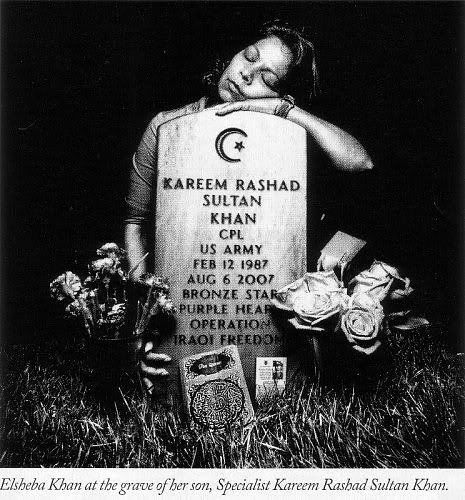
I feel strongly about this particular point because of a picture I saw in a magazine. It was a photo essay about troops who were serving in Iraq and Afghanistan. And one picture at the tail end of this photo essay was of a mother at Arlington Cemetery and she had her head on the headstone of her son's grave. And as the picture focused in you could see the writing on the headstone. And it gave his awards: Purple Heart, Bronze Star. Showed that he died in Iraq. Gave his date of birth, date of death, he was 20 years old. And then at the very top of the headstone, it didn't have a Christian cross, didn't have a Star of David. It had a crescent and a star of the Islamic faith. And his name was Kareem Rashad Sultan Khan. And he was an American. He was born in New Jersey. He was 14 years old at the time of 9-11. And he waited until he could go serve his country and he gave his life.

Now we have got to stop polarizing ourselves in this way. And John McCain is as nondiscriminatory as anyone I know but I'm troubled about the fact that within the party we have these kinds of expressions.

Tuesday, October 21, 2008

Powell's Endorsement

" To those who would say he is only supporting Obama as a fellow African American, Powell pointed out that if this were the criterion, he could have made his endorsement months ago. Much more important, I think, is that Powell is a moderate Republican who listens to all this innuendo about terrorism and all this nonsense equating the income tax with socialism and wonders what in the world has happened to his once-grand old party."

That's all folks.

Wednesday, October 15, 2008

THE NUMB3RS

There are now no fewer than seven current national polls that show Obama with a double-digit advantage: Newsweek (+11), ABC/Post (+10), Democracy Corps (+10), Research 2000 (+10), Battleground (+13), Gallup (+10 using their Likely Voter II model) and now this CBS News poll. 

The numbers speak for themselves. Though having a few prominent conservative philosophers speak out against McCain surely doesn't hurt either. Chris Buckley (son of William Buckley Jr; founder of the conservative publication, the National Review) resigned over the weekend after public outcry regarding his column last week in which he asked McCain why in the world he would have chosen Palin as his VP. He is the second columnist at the NR to question the choice of Palin, following in the footsteps of Kathleen Parker who received 12,000 pieces of hate mail after her original column,urging Palin to step down, was published in the NR.  Buckley quoted Ronald Reagan as he left the NR, saying "I haven't left the Republican Party. It left me."

If Colin Powell endorses Obama after the debate tonight, as expected based on his views on the management of the Iraq war, it will be "the final nail in the coffin of the Republican campaign to hold onto the White House. "

The conservative politicos are in a real quandary with this election, as the republican party faces an identity crisis which is playing out on the national stage. The fringes of the party have become more extreme, openly shouting "terrorist" and "kill him" at their rallies, and Palin has fit right in by stirring up the pot. Meanwhile many of the mainstream republicans have found appeal in the policy proposals of Obama and Biden. The Republican party no longer stands for the small government (just look at the bailout package the Bush administration proposed) or family values (many have been disillusioned with the political scandals that have plagued the evangelical republican base in recent history). It is increasingly apparent that the republicans don't have time to reorganize themselves in time for this year's election, but the party will have to do some extensive soul searching after November in order to solidify a conservative philosophy with a platform relevant in the 21st century. Such a platform would have to appeal to some of the moderate and yes, evangelical, voters which have been leaving the party in droves. This must include practical environmental policies (drill here, drill now is in no way practical or sufficient- the oil won't be available for 30 years!), an embrace of  the civil rights of individuals based on the foundations of the constitution (which the Bush administration has mauled so horribly in the past 8 years), moderate social policies to address poverty in America (an increasingly important issue among the "religious right"), and base it all on a philosophy of governance that does not include the types of Rovian politics seen of late. The road ahead is a steep one indeed. 

Thursday, October 9, 2008

Palin/ the Bush Administration and Reproductive Rights of Women

Gov. Palin's nomination as the GOP VP candidate has been accompanied by discussions of her views on sex education, rights of women, and her stance on abortion. As a staunch conservative her views are pro-life and pro- abstinence-only sex education. Her opinions on the matter are based on her personal and religious convictions to which she is entitled, as you and I are entitled to our opinions. However the efficacy of abstinence only education for American teenagers is a legitimate concern of many. In addition, recent policy changes in the Bush administration on the subject are, regardless of one's personal convictions, failing women in Africa we have pledged to assist and are on the brink of failing to protect American women's right to access comprehensive health care information. 

Teenage Hormones
The age at which teens become sexually active is the same (17) across the modern industrialized nations, however the pregnancy, abortion and STD infection rates vary greatly. This is, in part, because of the ways these teens are educated about the consequences of their choices. In today's Post, Amy Schalet compared the pregnancy and abortion rates of the US to those in the Netherlands. Teens engage in the same behaviors, but the difference? Dutch teen pregnancy rates are six times lower than in the US, and the abortion rate is significantly lower as well.  Similarly, in Canada, the pregnancy rate is half what ours is. 
 Like some other controversies at the heart of the culture wars, this problem -- which, after receding nationally since the early 1990s, appears to be worsening again -- need not exist. High teen pregnancy rates result in part from our inability to talk honestly and wisely about teen sexuality. And they are exacerbated by policies that prohibit such talk.
Imposition of Policies 
US AID quietly decided this week to prohibit a British aid organization, Marie Stopes Int., from distributing any contraceptives which are paid for by the US. The intent of the policy is to punish China for their population control program  through force abortions, because Marie Stopes Int. is a provider of family planning services in China (they maintain they have not ever been a part of the force-abortion policies). While it is admirable that the Bush administration is attempting to stand up to this policy, the tragic side effects are that women in Africa will not have the access to family planning resources that they once had. The Bush Administration is not simply targeting Stopes' abortion services, the administration is taking condoms, birth control and IUD's away from clinics that desperately need them. Marie Stopes International supports numerous rural clinics throughout Africa, and in many communities are the only source of contraceptives and simple reproductive health care. 
“This nearsighted maneuver will have direct and dire consequences,” a group of prominent public health experts in America declared in an open letter, adding that the action “will translate almost immediately into increased maternal death and disability.”
It seems unconscionable that those deciding upon the appropriate course of action to penalize China for their policies, would adopt a policy that indirectly affects the world's most vulnerable, African women of no means. In the irony of all ironies, many of these women will resort to abortions (in Africa these are not the sterile, safe procedures the West is familiar with) because they were unable to appropriate methods of birth control. Those that do not abort their unwanted pregnancies will risk greater poverty by feeding an extra child. In some parts of Africa a woman now has a one in ten chance of dying in childbirth. The idea that US policy may increase that toll is infuriating. 

Conscience Objections in the Medical Field
In late August HHS announced a proposed rule with the intent of providing greater protection to medical employees who have moral objections to particular medical procedures, particularly abortions. Laws of this kind were first passed in the 1970's to allow individuals to object to performing medical procedures on religious grounds. The law protects the critical first amendment rights of individuals in the medical field. However there is concern that the recently proposed regulations are too vague and will allow doctors, nurses and other medical staff to interpret anything (including the provision of emergency contraceptives to rape victims) as objectionable and therefore refuse service. Many would agree that doctors have the right to not perform particular services based on their personal convictions. The disagreement arises when they are allowed to define for themselves what is objectionable, and refuse women access to services that they want or need. Hillary Clinton has been particularly outspoken on this issue, while others are convinced the effects of the regulations, if made final, would be less severe.  HHS opened the regulation up for comment letters and is currently in the process of reviewing them before making final decisions. Whether or not the regs are finalized, HHS should include more specific language to protect patients and ensure that they are always given access to comprehensive information and services, even if a specific doctor is will not accommodate their desires.   

Wednesday, October 8, 2008

Obamacans for Intelligence

In a rather fascinating interview today, David Brooks (The conservative political philosopher of our generation) came out strongly against Gov. Palin because of her inexperience and spoke briefly about Sen. Obama's strong suits. 
When I first started in journalism, I worked at the National Review for Bill Buckley. And Buckley famously said he'd rather be ruled by the first 2,000 names in the Boston phone book than by the Harvard faculty. But he didn't think those were the only two options. He thought it was important to have people on the conservative side who celebrated ideas, who celebrated learning. And his whole life was based on that, and that was also true for a lot of the other conservatives in the Reagan era. Reagan had an immense faith in the power of ideas. But there has been a counter, more populist tradition, which is not only to scorn liberal ideas but to scorn ideas entirely. And I'm afraid that Sarah Palin has those prejudices. I think President Bush has those prejudices.
Brooks went on to comment on two of Obama's strongest presidential qualities: his intellect and his social perception. The first is demonstrated in a story Brooks tells about asking Obama if he had ever read Neihbuhr, to which Obama responds with a very thorough and nuanced understanding of his theories. Second, Brooks notes his social perception and ability to pick up on the more human side of policy debates. This, Brooks argues, is why Obama is in politics and not simply in the world of academia. Brooks most certainly disagrees with Obama on all major policy positions, but the interview is a shining example of some of the other traits Obama has, aside from policy positions, that would make him a good president. 

Since When is Intelligence a Bad Thing?

There was a great deal of talk in the recent VP debate about 'main street' and 'outsiders' coming to Washington, and the argument that this would a good thing as compared to the so called 'elites' who are currently ruining our nation from DC. The argument is a hypocritical and faulty at best. Those who run 'Washington' (the term has simply become shorthand for the federal government and all its branches and agencies) are both east coast elites with ivy league educations and representatives from every walk of life from every corner of this great nation.  Anne Applebaum argued yesterday that contrary to the political rhetoric of the day, Washington 'outsiders' are just as susceptible, if not more, to corruption and mismanagement of their posts. 
The District is not Manhattan. In Washington, the significance of this "elite" pales in comparison with that of the "hockey moms," "Joe Six-Pack" and "Main Streeters" who have dominated the political conversation in the nation's capital for as long as I can remember... I am thinking here of Sen. Ted Stevens of Alaska (a resident of Girdwood), now on trial on charges of corruption, and Texas Rep. Tom DeLay(born in Laredo), who resigned in disgrace. For the sake of bipartisanship, I'll mention Louisiana Democratic Rep. William Jefferson (originally of Lake Providence), recently indicted on charges of corruption. But if more small-town Republican names come to mind, that's because small-town Republicans have figured among the most powerful and most prominent Washington politicians for much of the past decade. 
The bottom line is that the 'elites' of DC have, in recent history, been less corrupt in the back rooms of Washington, but they are by no means immune to the temptation.  But where then, have they gotten such a bad reputation? When did this become the standard by which our leaders should be judged? Individuals with ivy league educations have turned out to be some of our best and some of our worst presidents. 

The qualities on which we should be casting votes should be proposed policies, leadership traits, decision making skills- not where the candidates come from or what type of education they may have. Military experience and time at Harvard are both incredibly valuable experiences for anyone, and can impact how one would define themselves as a president. 

The debates were telling in that they were an avenue through which the candidates could articulate their policies, demonstrate how their experiences have uniquely shaped them, and help voters understand the philosophies guiding their thinking and policy making. 

Gov. Palin failed largely on this in last weeks VP debate. Palin defended the government’s $700 billion rescue plan. She defended the surge in Iraq, where her own son is now serving. She defended sending more troops to Afghanistan. And yet, at the same time, she declared that Americans who pay their fair share of taxes to support all those government-led endeavors should not be considered patriotic. Whether you're from small town Alaska or an ivy league professor, that argument isn't logical and leads to cherry-picking priorities based on politics not sound philosophy. 

By contrast, in last night's debate Sen. Obama demonstrated a coherent philosophy on the role of government (health care as a right, not a responsibility) and was able to articulate his priorities should he be elected (While Sen. McCain implied it was un-American to set priorities because we should be doing everything... talk about out of touch). People sometimes criticize Obama for being professorial. But tonight, I thought his calm, coherent explanations of policy were a distinct advantage. There’s nothing wrong with a man who speaks in full sentences. As the philosopher Ludwig Wittgenstein observed: “If you can’t say it, you can’t whistle it, either.David Ignatius

Tuesday, October 7, 2008

Broken (health) Care of Every Kind

Today's edition of the Washington Post has a Mother's powerful story about her daughter's battle with a heroin addiction. The story sheds light on the (wrong) assumption of many Americans that help for substance abuse is available, should we or our loved ones ever need it. The truth is much different. Care is available for those with the right insurance (though with the passage of the Mental Health Parity Act, insurance companies will be required to cover necessary treatments as the cover other medical treatments), who end up at the right facility under the right circumstances. For example, prisoners receive addiction treatment before those who haven't committed crimes at many community health centers. The story is a tragic reminder that though the medical expertise is available to help those in dire need, insurance companies and one's socioeconomic standing are preventing many Americans from getting the help they need in order to return to their communities as productive members of society. 

Friday, October 3, 2008

The VP Debate: What We Already Knew

Last night's VP debate demonstrated what many of us already know: Senator Biden is incredibly knowledgeable and articulate, while Governor Palin appeals to some "soccer-moms" but is unfamiliar with both the domestic and foreign policies (other than energy issues I suppose, which she returned to when asked about various other topics) which she and Senator McCain stand for. Neither made any huge gaffe's, though both had some minor mistakes that are typical in political debates of this nature. 

Did Gov. Palin win, as some commentators like
Pat Buchanan have claimed? No. It is abominable that the expectations for a vice presidential candidate in a debate were simply to show up and say a few quasi-logical things. To say Gov. Palin won, because she met those "expectations" is absurd. They was hardly anything to the expectations to begin with. 

The biggest challenge for the VP nominees going forward in the next four weeks will be convincing Americans that they are qualified for the job. According to the 10/1/08 Pew Research Center polls, Biden is ahead on this.  The public is increasingly worried about Palin's qualifications and is also gaining confidence in Obama's ability to lead. This is, in large part, because of his performance (and McCain's flop of a performance) in dealing with the bailout legislation. 

Sen. Biden is one of the most knowledgeable senators serving in the US Congress and that came through in last night's debate. His 90 second responses demonstrated both the big picture, philosophical understandings of problems and policies, as well as the minutia involved with his policy proposals. Simultaneously he appealed to average Americans as a father who struggled to care for his two sons after the death of his wife and daughter, who understands the "kitchen table discussions" that worry so many voters. 

In contrast, Palin failed to convince viewers that her policy positions are sound and the she will be able to execute them appropriately should she and McCain be elected. Had she been able to do that, a claim to victory would have been valid. For one, Palin botched the strategy and the name of the US commander in Afghanistan.
"Now, in most cases, this type of oversight on the part of a politician could be dismissed--maybe even attributed to nerves. But when Afghanistan is exploding and on the verge of failure, details matter. Facts matter. Being familiar with the situation matters--a lot. The troops depend on it." 

That Palin could not articulate her guiding philosophy behind the position of the vice presidency is terrifying to Americans who have seen the Constitution and our civil rights eroded under current VP Cheney. That Biden understood the constitutional issues at risk, and clearly defined how he would operate within them, provided  confidence and comfort to voters that Palin was unable to give.  
"She went into this debate with most Americans believing she is unqualified for the office. She did nothing to dispel the doubts voiced about her-- even by Republicans--and frankly reinforced those doubts mightily." 

Nor could she come up with an answer to the achilles heal question, or the question about campaign promises that won't be met. That one is unable to admit to the realities of one's own and one's party weaknesses demonstrated a world view in line with that of the Bush Administration, a disheartening fact for a population that is fed up with the guiding philosophies and policies that have emerged in the last 8 years. 

Thursday, October 2, 2008

Questions for the VPs

Similar to the questions posted for the Presidential debate last week, today's New York Times poses a number of questions, from various policy makers and analysts, to the VP candidates for their debate tonight.

Senator Biden, do you believe that continued withdrawal of American troops from Iraq will lead to a newly ignited civil war?

Governor Palin, since you were selected as a vice presidential candidate, Mahmoud Ahmadinejad has given more press conferences to American reporters than you have. Why do you have less confidence in the American press and people than the president of Iran does? And when will you dare to face the press for real?

— ANDREW SULLIVAN, a blogger for The Atlantic and the author of “The Conservative Soul”

Can the vice president shift between branches at his convenience? If not, what, in your view, is the constitutional status of the vice presidency?

— GENE HEALY, the author of “The Cult of the Presidency: America’s Dangerous Devotion to Executive Power”

Governor Palin, I love my frontier state, but the first thing I learned when I moved to the Lower 48 was how unlike the rest of the country Alaska is. How would you govern America when as mayor and governor, you hardly had to provide basic public services? In Wasilla, less than a tenth of the town is connected to the sewer system.

Alaska’s economy runs on oil proceeds — we don’t even pay income tax. And despite our disdain for Washington, we are given hundreds of millions of dollars from the federal government each year. How would you handle our financial crisis when you’ve never had to balance a budget while tax revenue fell?

— RACHEL KLEINFELD, the executive director of the Truman National Security Project.